Blog

Recipes

Chickpea Brownies

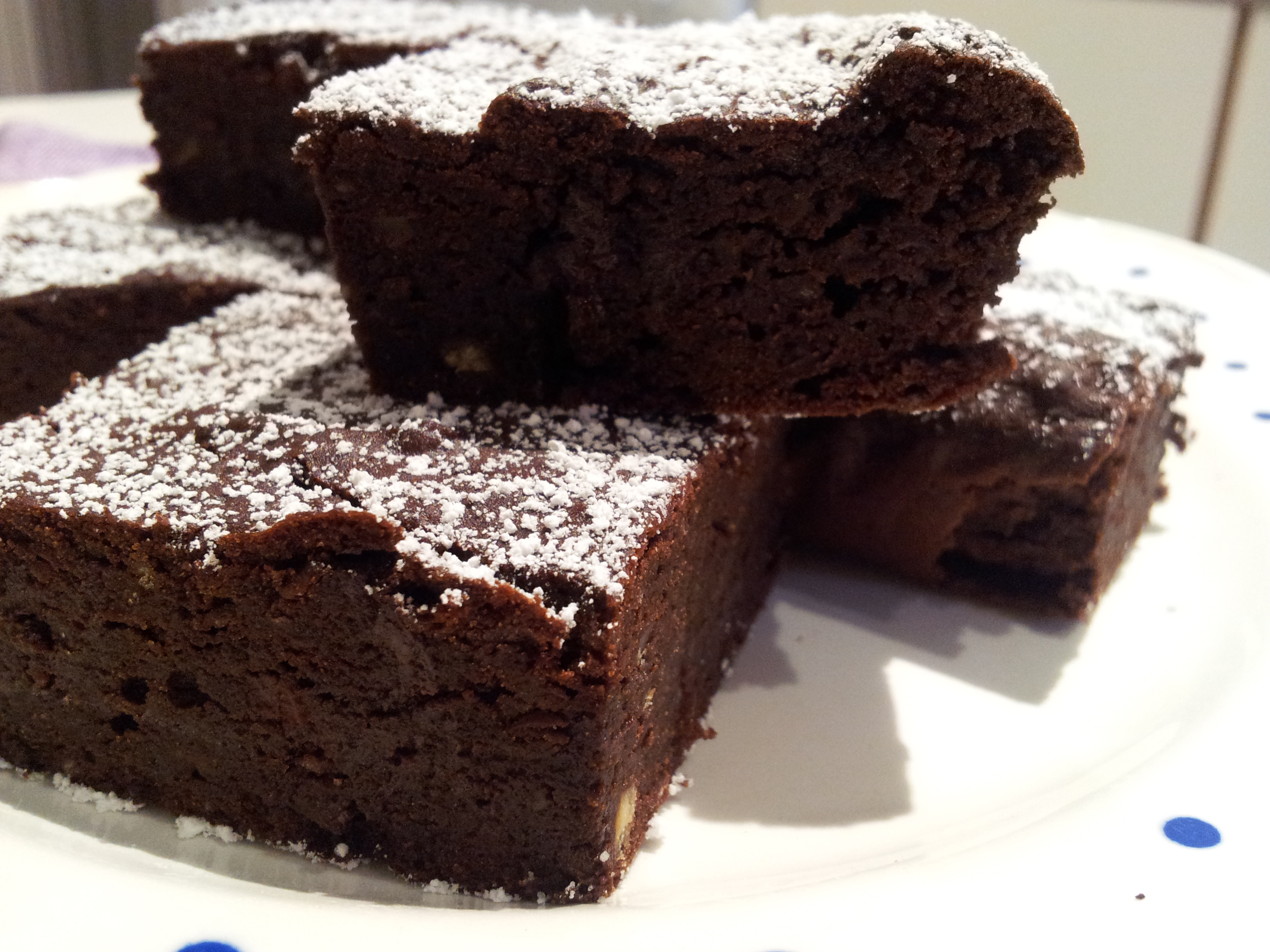
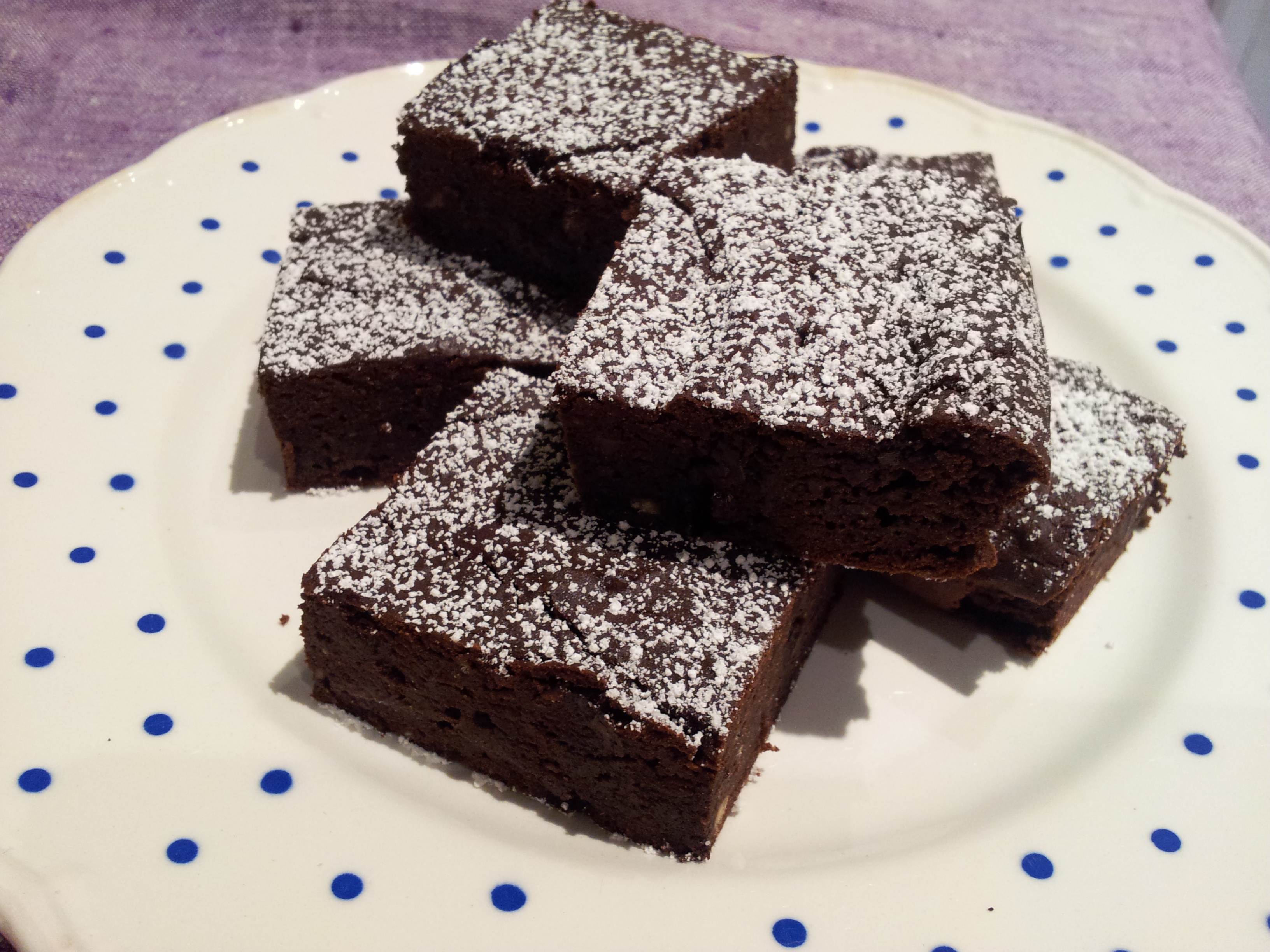
20150329_180015These gooey, delicious mouthfuls of chocolate indulgence are the perfect bake for the Easter holidays! Chuck all the ingredients into a food processor, throw in the oven and…voila!!

Honestly…don’t let the chickpeas put you off. They taste fantastic! Plus, they’re suitable for those with coeliac disease as they are gluten free!

The fact that they contain more protein than your standard chocolate brownie should help with satiety! The perfect sweet treat for a little bit of what you fancy!

Ingredients:
300g chickpeas
2 eggs
40g cocoa powder
80g sugar*
1 tsp coconut oil (melted)
1 tsp baking powder
1/2 tsp salt
20mls espresso coffee (optional)**
100g dark chocolate chips

*You can replace with sweetener if desired
**Another suggestion from a blog reader is to include marmalade in the mixture to give it an orangey taste…yum!

Method:
1. Preheat the oven to 180’c and line a baking tray with greaseproof paper.
2.  I used a bar of dark chocolate (at least 70%) and put it through the food processor to make chocolate chips. It’s a good idea to leave some bigger chunks as this adds to the gooey texture of the brownies. Tip this into a bowl for the moment.
3. Place the chickpeas, coconut oil, coffee and eggs into the food processor. Blend for a minute or so.
4. Mix together the dry ingredients (cocoa, sugar, baking powder and salt). Add this to the chickpea mixture in the food processor and continue to blend….well!
5. Once you have a smooth mixture, stir in your chocolate chips.
6. Now pour the mixture into the lined tray. You’ll need to flatten it a little as the bake won’t change shape much, so ensure it looks how you want it to.
7. Place in the oven and bake for 40-50 minutes, until the top is firm to the touch and the surface has begun to crack. A toothpick should also come out (relatively) clean.
8. Let the bake cool completely before cutting into 12 pieces. Dust with icing sugar, and serve 🙂

The nutritional information below is per brownie:20150329_175956
CALORIES: 134kcal
TOTAL FAT: 4.8g
SATURATED FAT: 2.5g
PROTEIN: 4.25g

I love receiving pictures of you making my recipes:

17116_10155461771410389_1640994925453148783_n

rachel brownies

Recipes

Chickpea and spinach risotto

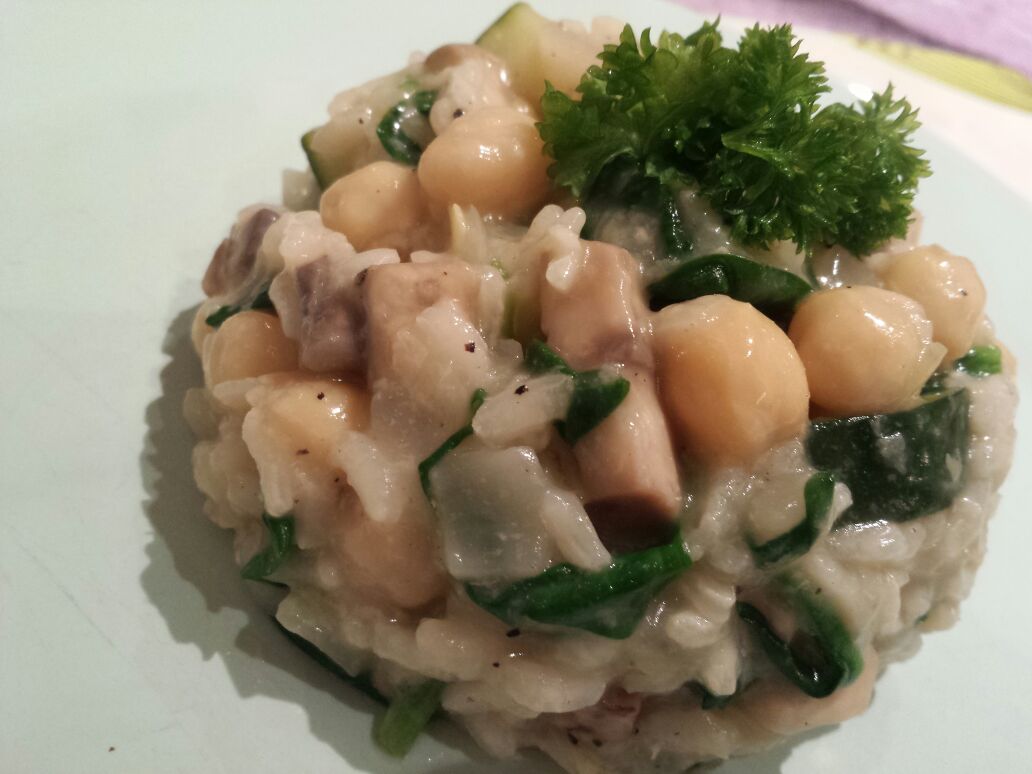
Risotto is a bit of a go-to for me. I like the whole one-pot thing it’s got going on, and I also find its gooey deliciousness indulging and comforting. Risotto is also easy to adapt by adding different vegetables and ingredients. This particular recipe is often one I use when I’ve forgotten to get meat out of the freezer, or one for meat free Monday!

IMG-20150304-WA0005Ingredients (serves 2):
100g risotto rice
100g chickpeas
1 large onion (chopped)
2 cloves garlic
1 tablespoon butter
100ml dry white wine
100g mushrooms
200g spinach
100g courgette
1 tsp oregano
Lemon zest
500ml stock + water
Salt and pepper to season

Method:
1. Heat the butter over a low heat in a large saucepan big enough to hold all of the ingredients. Add the chopped onion, garlic, oregano and seasoning. Stir the onions and keep cooking them till they become translucent, don’t let the garlic burn.
2. Add in the risotto rice and allow the grains to heat up slightly. Then, pour in the white wine. It will sizzle and smell amazing.
3. Let the rice take up the white wine, and when it is all absorbed add a small amount of the stock. This is where the continuous stirring comes in. Little stock, stir, let rice absorb, stock, stir, absorb…..
4. When you’re about half way through your stock, add in the mushrooms, courgette and chickpeas. Then, continue to add the rest of the stock little by little. (If your rice hasn’t cooked but you’re out of stock, continue the same process with water until the rice is cooked.)
5. For the final few minutes, add the spinach and allow it to wilt into the risotto before stirring in. I like to add a little lemon zest here too but that’s optional!
6. Taste, and season further if required. Serve and enjoy (a little Parmesan would also work nicely!)

The nutritional information below is per serving:
CALORIES: 430kcal
TOTAL FAT: 8g
SATURATED FAT: 4g
PROTEIN: 14g

Recipes

Mediterranean Hotpot

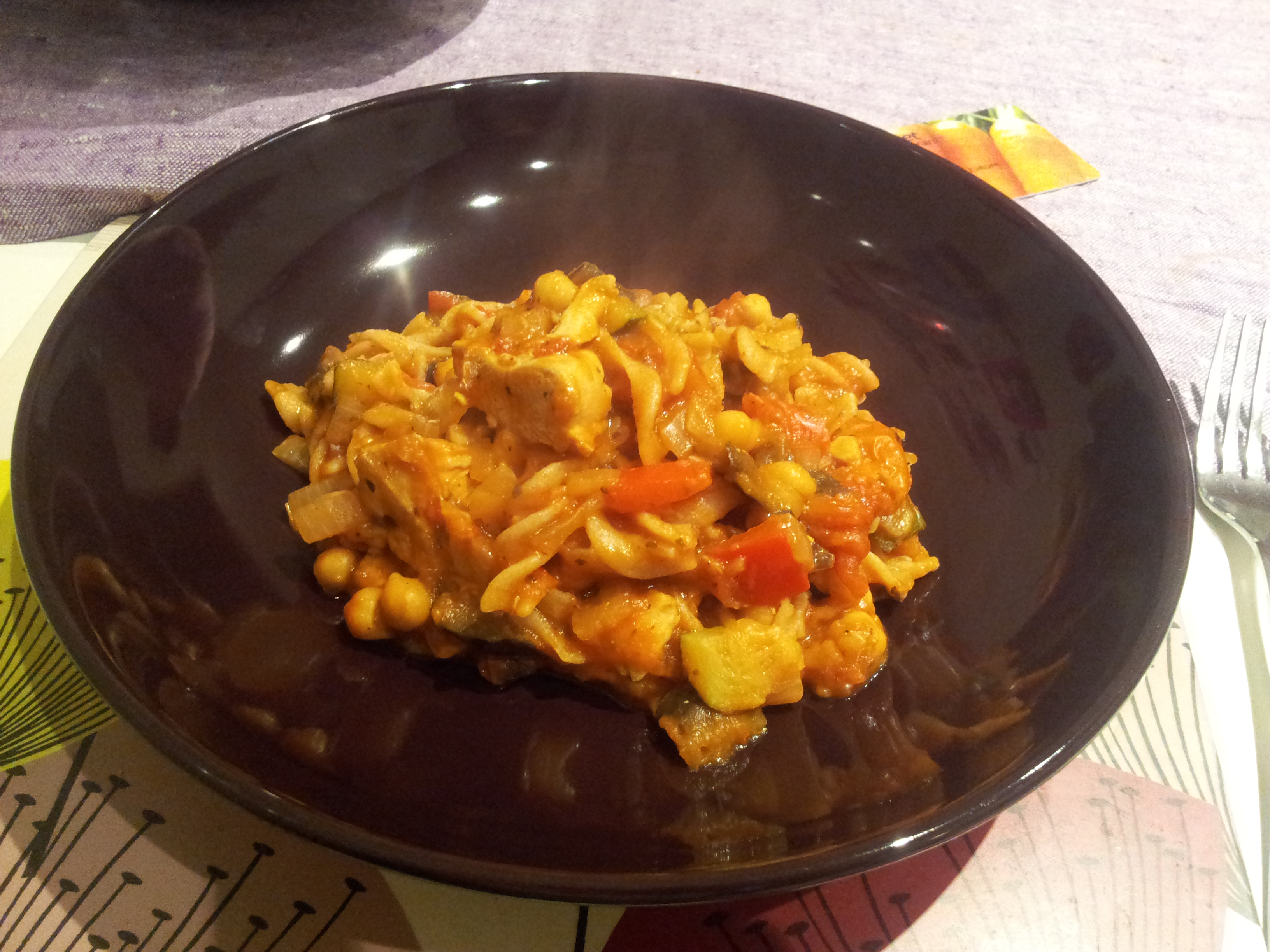
I’m a big fan of Mediterranean food because it’s healthy, tasty, comforting and, typically, easy to make. You can pretty much throw in any veg and it goes well together. When it comes to dishes like this, I tend to just use up what veg we have left. Consequently,this recipe probably isn’t one for those who like precise, follow-to-the-letter recipes. However, it’s quick, sooo easy and packed with vegetables, fibre and protein.

Serves 4

20150303_184130Ingredients

Chicken (I used 2 breasts, diced into bitesized chunks)
2 large onions
2 tbsp vegetable oil
1 tin of chickpeas, drained
1 aubergine
1 courgette
Mushrooms (a couple of handfuls)
1 pepper
1 chili
2 cloves of garlic
Cherry tomatoes (a couple of handfuls)
1 tin of chopped tomatoes
Water
1 tbsp basil
1 tsp thyme
1/2 tsp turmeric
Salt & pepper to taste

Method

1. Add the oil to a large pan and heat on low.
2. Dice the onions, finely chop the garlic and add to the pan. Leave to soften for a few minutes.
3. Add the bitesize chicken chunks to the pan and leave for 5-10 minutes to cook. Meanwhile, chop all your remaining vegetables.
4. Put the vegetables (aubergine, mushrooms, pepper, courgette and tomatoes) into the same pan, along with the chili, herbs and spices. Season if desired.
5. Add the tinned tomatoes and water (I add a further tin full of water). Stir well and leave for 5-10 minutes with the lid on.
6. When the vegetables have begun to cook and the contents of the pan has reduced a little, add the chickpeas. Stir again, and leave for 10-15 minutes with the lid on, stirring periodically.
7. Check the chicken is cooked through and the sauce is piping hot. Your hotpot is ready!

HINT 1: If you want, you can use this dish as a ‘sauce’ for pasta (as pictured above)
HINT 2: A little crumbled feta tastes great on this dish!

The nutritional data below is based on the above ingredients yielding 4 portions (not including pasta):
CALORIES: 300kcal
TOTAL FAT: 9g
SATURATED FAT: 1.2g
PROTEIN: 19g

Recipes

Roasted Chickpeas

I’ve been making these for a while, but not got round to posting a recipe. These are great for those people who like to nibble, they have the crunch of crisps, but less saturated fat. Chickpeas are also a great source of protein and soluble fibre, which helps keep you fuller for longer.
They’re super easy to make and you can change the flavour so you don’t get bored. They are slightly addictive though, and (unless you’re okay putting up with the repercussions of bean-overload)…I’d recommend only having a handful at a time!

Ingredients:roasted chickpeas
1 tin of chickpeas
1 tablespoon olive oil
1 tablespoon paprika
Salt & pepper to season

  • Alternatives:
    – S
    wap the paprika for pretty much any spice you like (curry, chili powder, you could even try mustard!)
    – Swap the olive oil for coconut oil and have with cinnamon and honey for a sweeter alternative (omit the pepper).

Method:
1. Preheat the oven to 200’c.
2. Drain the chickpeas and rinse under cold water.
3. Tip the chickpeas onto some kitchen roll and rub dry. This will remove some of the husks (that’s okay!)
4. Add the chickpeas into a bowl along with the oil and your choice of spices. Season as desired and mix well, ensuring every chickpea is coated.
5. Place onto a baking tray and into the oven.
6. Roast for about 30-40 minutes until the chickpeas are crispy. The longer you leave them, the crispier they’ll get – just don’t let them burn!
7. Allow to cool, and serve. Store in an airtight container and they keep well.

The nutritional information below is per 45g portion:
CALORIES: 90kcal
TOTAL FAT: 3.5g
SATURATED FAT: 0.5g
PROTEIN: 4g

Recipes

One-pot chicken saag

I love curry! Be it lamb, chicken, prawn, spicy, mild…I just love how diverse they are. I enjoy making curries from scratch, but what I don’t enjoy is the amount of time and effort that it takes to make the paste (and the extra things you have to wash up afterwards!)

But, fear not!

I’m a one-pot dinner kinda girl, and this recipe can be made in one (or rather two!) pots as you can add the spices straight to the pan. No paste making = less washing up. AND it tastes amazing. It’s also up to 150 calories less than you would consume in a takeaway version of the same curry.

WIN WIN WIN!

Serves 4

curry1Ingredients

Chicken – (I used 4 breasts, but have also made this using leftover meat from a roast chicken)
Spinach – 300g
Onions x 2 large
Garlic x 5 cloves
Vegetable oil – 2 tablespoons
Fresh diced ginger – 1-2 teaspoons
1 tin of tomatoes
Splash of milk
1 fresh chili
Ground coriander – 2 teaspoons
Cayenne pepper – 2 teaspoons
Ground turmeric – 1 tablespoon
Garam masala – 1 tablespoon
Cardamom pods x 4
Cloves x 4
Bay leaf x 2
Salt & pepper to taste

Method

1. Add the oil to a large pan big enough to hold all of the ingredients. Finely chop the onions and the garlic, add to the pan and fry on a medium heat.
2. Slice the chicken into bitesized chunks, add into the same pan as the onions. While the chicken is cooking, place the spinach in a separate saucepan half full with water, boil for 5 minutes then remove from heat.
3. Once the outside of the chicken is browned off, add the ginger, chili, tinned tomatoes, coriander, cayenne pepper, turmeric, cardamom pods, cloves, bay leaves and seasoning (told you you’d need a big pan!) If there’s not enough liquid in the pan to cover the chicken, add a dash of water.
4. Simmer for 20 minutes until the chicken is cooked through and the curry is piping hot. Meanwhile, drain the water from the spinach and roughly chop it.
5. Add the spinach and milk along with the garam masala and stir into the curry.
6. Cook on a low heat for another 10-15 minutes.
7. Serve with brown rice or baked potato! Yum!

The nutritional data below is based on the above curry ingredients yielding 4 portions:
CALORIES: 300kcal
TOTAL FAT: 12g
SATURATED FAT: 2g
PROTEIN: 33g

Healthy Living

5 ways to encourage kids to eat their vegetables

I meet so many parents who are concerned about their child’s lack of like for vegetables. First of all, rest assured that you are not alone. Secondly, don’t panic! Research suggests that it can take up to 15 exposures to a new food before a child will eat it. Meanwhile, there are lots of things you can do to help try and encourage your child that broccoli is not the devil.

1. Introduce fruits & vegetables early

It is well documented that the more familiar a child is with a certain food, the more likely they are to eat it. Weaning is prime time for a child to get used to different tastes and textures. Unfortunately, parents can sometimes become too worried about ‘how much’ their child is eating rather than appreciating that one of the main aims of weaning is to introduce the child to a wide range of tastes and textures. This can lead to parents just providing foods they know the child will eat, hence decreasing the number of exposures to foods they don’t. In short, always include ‘disliked’ vegetables on the plate, even if your child doesn’t eat them!
Parents can try ‘tricks’ like combining an already liked vegetable on a plate with a new one. Research shows that children are more likely to eat more of the new vegetable if it were presented with a familiar one as oppose to on its own. Vegetables also make great finger foods (not just for weaning!) and children are often more likely to be excepting of something when they can touch, taste, smell and play with it themselves first. 

2. Involve your children

Make your job easier in more than one way by getting your kids to help you prepare meals! When kids can see what is going into food, and when they’ve played a part in making it, it suddenly becomes fun and engaging and can lead to them wanting to try what they’ve made.
To what extent you involve them can vary depending on what you have time to do and how old they are. You could build a veggie patch together in the garden (or if you have little space, try growing herbs), take them to the market/shop to choose what vegetables they’d like for dinner and what fruit they’d like in the fruit bowl. Or even just let them put their food on their plate or sprinkle extra vegetables onto their pizza. 

3. Lead by example

There is a lot of research indicating that children pick up their eating habits from their parents. This stretches from types of foods eaten to the environment in which it becomes normal to eat. If you yourself are a fussy eater, then it’s likely that your child will pick up your habits. Try not to show your dislike for something. Always have vegetables on your plate. If you don’t eat them, your child doesn’t see why they have to either!
Try and have fruit and vegetable snacks within easy reach. If your child sees you munching on an apple, this becomes the norm rather than munching on a packet of crisps or biscuits. Soon they’ll be asking you for a piece!

4. Try presenting fruits & vegetables in a different way

So I mentioned how combining new veggies with those already liked can help. Well how about combining veggies with foods already liked in general? Adding fruits or vegetables to favourites like pizza, omelettes or breakfast cereals can help encourage your child to try them. Try to involve your child in this though, as changing something too much without them knowing could put them off the food they did like!
Slicing or shaping them in certain ways may help too. Making a face from them on a plate, aubergine cut with a heart cutter; you could even let them chose a cutter!
Try different cooking methods, consistencies and flavours. Give something raw that you’d normally cook, or cook something you’d normally give raw. Won’t eat a whole apple? Try slices, stewing it with a little cinnamon or grating it onto their breakfast porridge. Serve things like carrot, cucumber and pepper slices with hummus or another dip for a way to change things up a bit. Don’t like cauliflower? Try cauliflower cheese. (Cauliflower also blends easily and works as a great thickener for soups.) There is mixed evidence about ‘hiding’ vegetables in your child’s food, but methods such as blending/mashing to disguise vegetables normal appearance may be a good way of getting them used to the taste initially. There’s also lots of recipes available online that ‘hide’ vegetables by presenting them in a totally different form, things like; smoothies, frozen lollies made from fresh fruit and even cake recipes!
Serving fruits and vegetables in an atypical way with a new spice or flavour could lead you to a breakthrough!

5. Don’t fight over it

There are also a couple of things you should try to avoid doing to get your child to eat fruits and vegetables. Although it can get very frustrating, forcing your child to eat certain foods or finish their plate is not going to help the situation. Some research suggests that it can even put a child off that food for life!
Bargaining can also lead to a developed habit where your child won’t do anything unless they get a reward for it! Ideally, try to let your child decide when they’ve had enough, show a neutral reaction, remove the plate and just try again another day. This technique can also help them develop healthy habits in later life of stopping when they feel full.

More information & references:
NHS (UK) 5-a-day: http://www.nhs.uk/Livewell/5ADAY/Pages/Family.aspx
NHS (UK) How to involve your child in being healthy: http://www.nhs.uk/Livewell/childhealth6-15/Pages/Get-children-involved-inbeing-healthy.aspx
Borah-Giddens, J., & Falciglia, G. A. (1993). A meta-analysis of the relationship in food preferences between parents and children. Journal of Nutrition Education.
Cooke, L. (2007). The importance of exposure for healthy eating in childhood: a review. Journal of Human Nutrition and Dietetics.
Lerner, C., & Parlakian, R.  (2007).  Healthy from the start:  How feeding nurtures your young child’s body, heart, and mind.
Olsen, A. et al. (2012). Children’s liking and intake of vegetables: A school-based intervention study. Food Quality and Preference.
Olsen, A. et al. (2012). Serving styles of raw snack vegetables. What do children want? Appetite.
Wardle, J. et al. (2003). Modifying children’s food preferences: the effects of exposure and reward on acceptance of an unfamiliar vegetable. European Journal of Clinical Nutrition.
Wardle, J. et al (2003). Increasing children’s acceptance of vegetables; a randomized trial of parent-led exposure. Appetite.

Healthy Living

6 things I bet you didn’t know about dietitians

Someone yesterday asked what I did, “I’m a dietitian,” I replied. In response to the confused look on their face I went on to elaborate; “I work in nutrition” I said, and this they understood.

This is not the first, nor I expect, the last time I’ve had to explain what a dietitian is. But what was said next is what inspired me to write this post, “I can’t imagine you’re very busy here in Brussels” and then, after pausing for reconsideration, “well, I guess there are a lot of Americans!”

Don’t even get my started on what annoyed me about this reply! Firstly, this is a prime example of weight stigma, and secondly this person was assuming that as I dietitian I only work with people in larger bodies. Every country across the world has people who are different sizes and shapes. Obesity is a global issue, and not one that is just restricted to industrialised countries either.  Anyway, I digress…this is a topic for a whole other blog post!

The purpose of this post was to highlight what dietitians do (and don’t do), in the hope that one day dietitians everywhere can reply “I’m a dietitian” and get the same smile and nod that people get when they reply “I’m a nurse” or “I’m a website designer.” (Well…a girl can dream!)

1. We are not the food police

March122010cagle

Contrary to popular belief, we will not lock you up and throw away the key if you tell us you have pizza once a week. Nor will you find us chasing our clients, or friends for that matter, away from the chippy/friteur waving a carrot! I have not yet met one dietitian who has told anyone that they can never have chocolate or ice cream again. Luckily for you, our four years of training includes all of that ‘moderation‘ stuff, in fact, we’re pretty good at it! So visit a dietitian and you can expect an empathetic, understanding professional who is hoping to help you.

2. We will not jump on the latest nutritional bandwagon

As dietitians, we are bound by a code of conduct. Dietitians all over the world are governed by different authority boards to ensure that the advice we give is based on robust evidence. This means that our advice isn’t just based on one study released by the college of natural living whose head-office is in a 1970’s portacabin in Nova Scotia! We check the quality of the evidence, duration of the study, sample size, conflicts of interest, where it was published and if other studies have found the same thing. The media may decide that 4 pomegranates a day is going to save your life, but chances are we won’t be recommending that you live on pomegranates until we’ve seen the evidence behind the claim.

3. We work hard to UNCOMPLICATE healthy living

lost-confused-unsure-unclear-perplexed-disoriented-bewildered-signs

It’s confusing. There’s lots of conflicting advice and the latest FAD seems to change on a weekly basis. Most of the time dietitians won’t talk nutrients unless there’s a need. We tend to look at the bigger picture and work on the basis that a balanced, varied diet should include all of the vital minerals and vitamins. We’re able to assess someones diet and conclude what they may not be getting enough of, but we’re likely to advise changes in terms of whole foods, not individual nutrients. Of course, there are exceptions if someone has specific symptoms or a deficiency, but generally it’s far less complicated if you think “I should include more fruit and vegetables today” as oppose to “I must increase my magnesium intake.”

4. We don’t just tell people to eat less

I know…amazing, right? Dietitians = diet. Urr, wrong! Firstly, to us, ‘diet’ is all we eat, not a short-term restriction (see my philosophy on diet for more on that). Secondly, we don’t just see people who want to lose weight. Actually, we see quite a lot of people who are struggling to gain weight! You’ll also find us helping people navigate their way round diets associated with allergies, breast-feeding, digestive problems, respiratory diseases…and by no means is that an exhaustive list. Thirdly, even those people we see who do want to lose weight, it’s not like we just sit and regurgitate what we said to the last guy! Every person is unique, that means different lifestyle changes, different goals, different needs, and therefore, often an entirely different and individual focus.

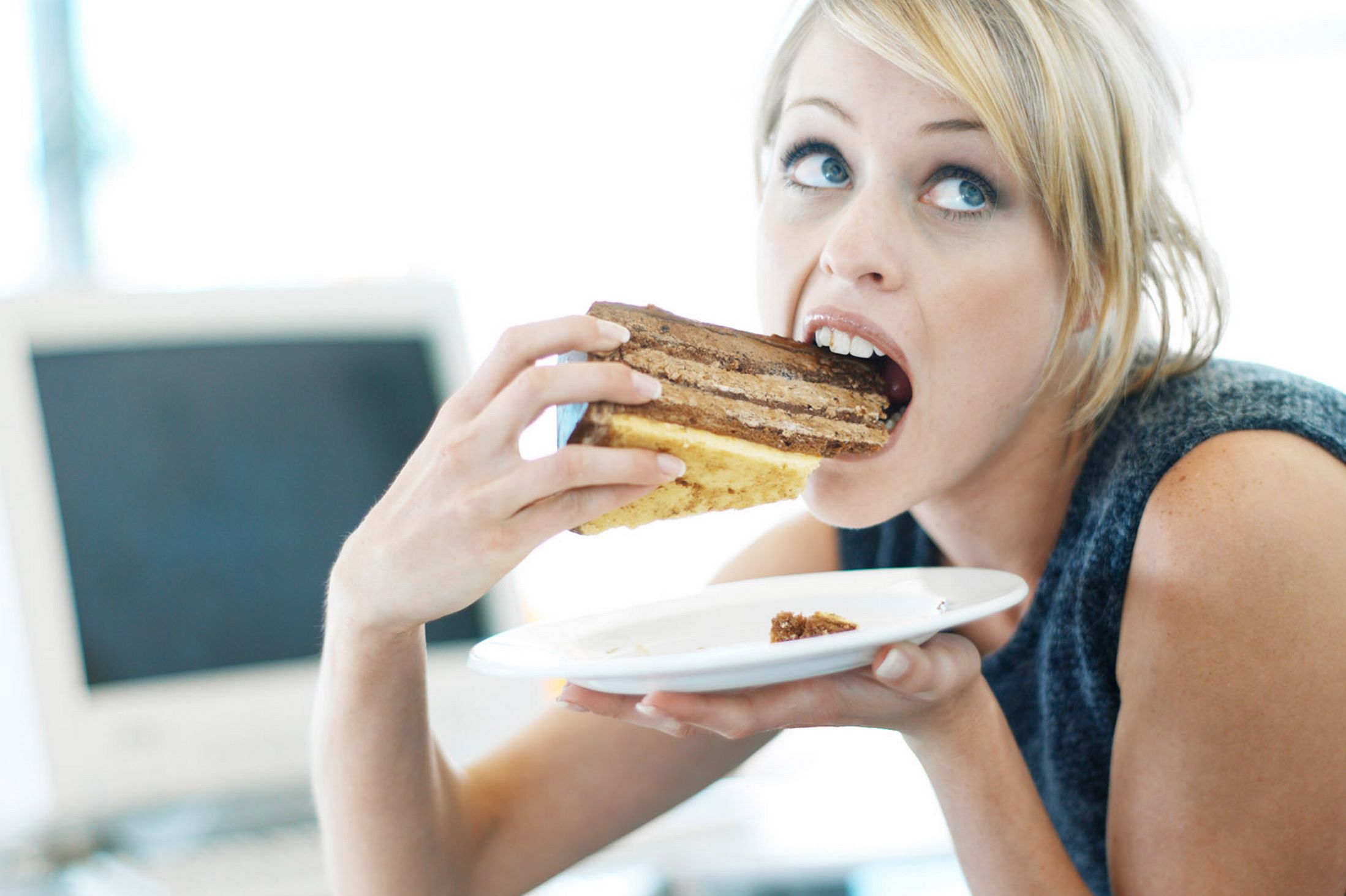
5. We eat cake

Close-up of a woman eating a large piece of cake

If it’s Sarah’s birthday, chances are we’re not going to say no to her mum’s renowned double chocolate sponge. If it’s a glorious sunny afternoon, you can betcha’ I’d fancy a lovely refreshing beer sat by the lake. WE.ARE.HUMAN.TOO.
I’ve lost count of the number of times people have said “oh, I bet you NEVER eat that” …Yawn. I’m a dietitian, a foodie. I love food. It’s one of the reasons I do what I do. Plus, I strongly believe that mental health is just as important as physical health, and if I deprived myself of chocolate every time I wanted some I’d probably not be a very nice person to be around. We just know that we can’t be indulging like that all the time.

6. We do not spend all day in the gym

Generally speaking, we’re actually quite busy people! Whilst we understand the importance of daily exercise, we also know what can happen if we push our bodies too far. Dietitians are not a breed. We are not all born with a stomach like Jessica Ennis and arms like Jennifer Aniston. And, as far as I know, being a certain size or shape isn’t a requirement on any Dietitian application form.

We are happy in the knowledge that what we eat and how we exercise is a balanced mixture of what’s good for the body, and what’s good for the soul.

More information:
World Health Organisation: http://www.who.int/nutrition/topics/obesity/en/

British Dietetic Association (BDA): https://www.bda.uk.com/
BDA: “what do dietitians do?”: https://www.bda.uk.com/improvinghealth/yourhealth/dietitians
European Federation of the Associations of Dietitians: http://www.efad.org/everyone
Recipes

Apple & Walnut Flapjacks

I love walnuts! They taste great in salads, yoghurts, cakes and on their own! They are a rich source of many minerals, while also providing protein, healthy fats and vitamin E. It’s very easy to add them into your diet, either as a snack or as an extra ingredient.

These flapjacks are lovely, and the apple/walnut combo is a match made in heaven!

20150205_182603Ingredients:
200g oats
40g dried apple
130g pureed apple
90g sultanas
40g chopped walnuts
2 tablespoons honey
50g low fat natural yoghurt

Method:
1. Preheat the oven to 220’c and line a baking tray with greaseproof paper.
2. Using a pair of kitchen scissors, chop up the dried apple into small chunks.
3. Mix together the oats, chopped dried apple, sultanas and chopped walnuts in a large bowl.
4. Stir in the pureed apple.
5. In a separate bowl, mix together the yoghurt and the honey, and then add that to the oats.
6. Make 20150204_102412sure all of the ingredients are well-combined, add them into the pre-lined tray and press them down slightly.
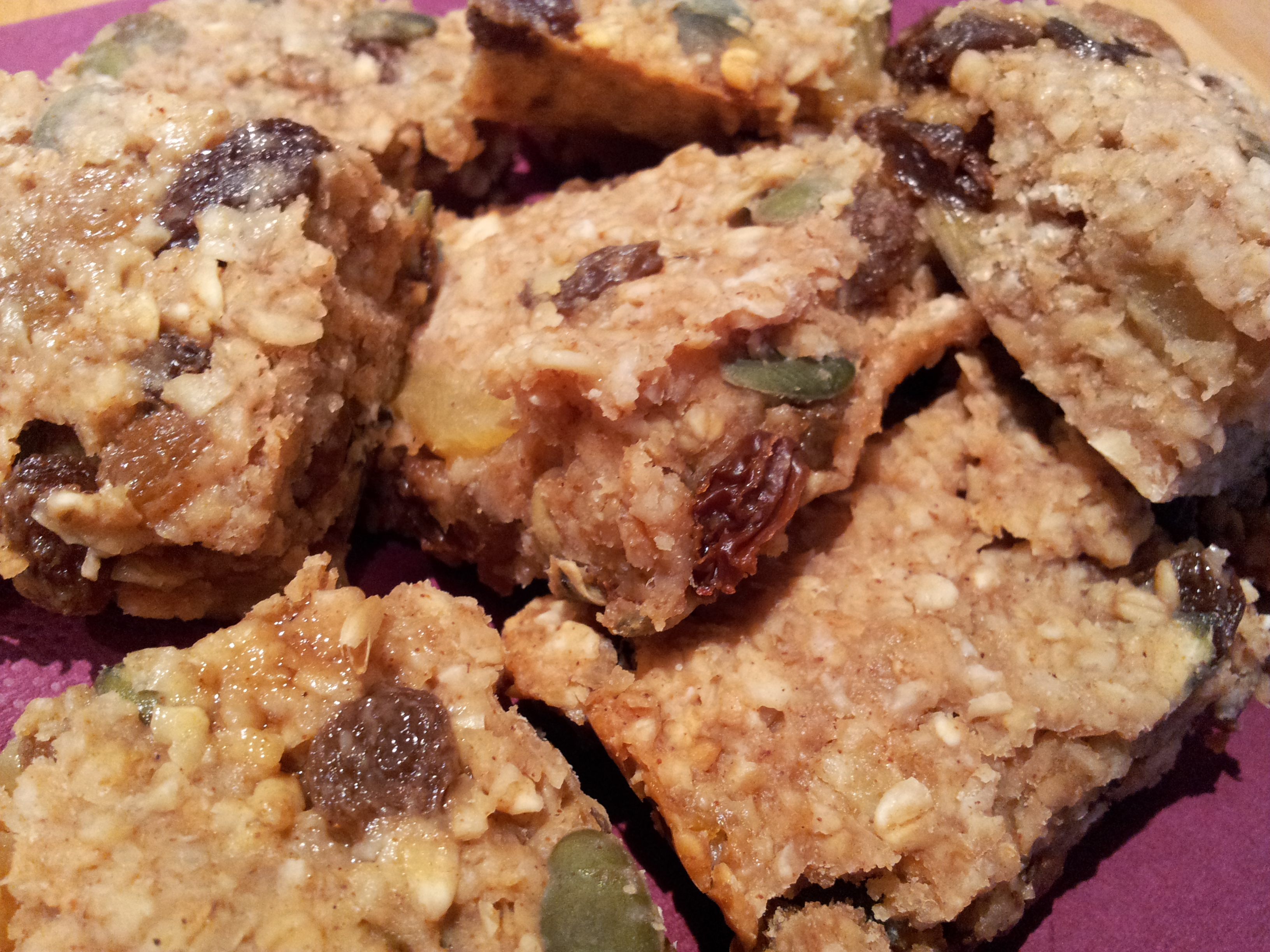
7. Pop in the oven for around an hour, or until the edges begin to crisp.
8. Slice into 12 pieces and store in an airtight container.

The nutritional information below is per portion:
CALORIES: 130kcal
TOTAL FAT: 3g
SATURATED FAT: 0.3g
PROTEIN: 4g

Recipes

Apple & Cinnamon Flapjacks

These flapjacks are delicious! I’ve added golden syrup which makes them chewy and sweet. They use yoghurt in place of butter so they’re lower in saturated fat than conventional flapjack recipes. They are a filling, healthier option for when you want something sweet.
I just love how you know exactly what’s in them, if you’d prefer them less sweet, then add less syrup! Although I must say, the gooey, chewy sweetness combined with the cinnamon flavour makes this recipe one of my personal favourites.

Ingredients20150127_145014
200g oats (use gluten-free oats if required)
130g sultanas
40g seeds (I used pumpkin)
5 tablespooons pureed apple
70g low fat natural yoghurt (should be gluten free, but double check!)
1 1/2 tablespoons golden syrup
1 tablespoon cinnamon

Method
1. Preheat the oven to 220’c and line a baking tray with greaseproof paper.
2. Mix together the oats, sultanas, seeds and cinnamon in a large bowl.
3. In another bowl, mix together the golden syrup, yoghurt and apple.
4. Add the liquids to the oats mix and stir the mixture until all the oats are covered and sticky.
5. Tip the mixture into the lined baking tray and flatten it down slightly.
6.  Pop into the oven and cook for around 30 minutes until the top appears golden.
7. Slice into 12 pieces and store in an airtight container.

The nutritional data below is per portion based on the above yielding 12 flapjacks.
CALORIES: 130kcal
TOTAL FAT: 2.8g
SATURATED FAT: 0.5g
PROTEIN: 4g

If you like these, try my Apricot and Pistachio Flapjacks.

Recipes

Almond & cranberry rock cakes

Sometimes you just need SOMETHING to go with that cup of tea, and SOMETIMES a piece of fruit just isn’t going to cut it 😉

These cute little rock cakes are perfect for those moment. They’re made with ground almonds which makes them high in protein and they don’t contain any butter which means they’re lower in saturated fat than your standard rock cake recipe.

If you fancy doing some baking today, give these a go!

Ingredients20150122_200353

100g ground almonds
80g plain flour
1 teaspoon baking powder
2 teaspoons ground ginger
50g dried cranberries
30g sugar
2 eggs
Honey (optional)

Method

1. Preheat the oven to 220’c.
2. Sieve the flour, and add it into a bowl containing the ground almonds, baking powder and ginger.
3. Add in the cranberries and the sugar and give it a good ol’ mix!
4. In a separate bowl, whisk the 2 eggs.
5. Add the eggs to the other ingredients and stir well until you have a sticky consistency.
6. Plop little dollops of the mixture onto a baking tray lined with greaseproof paper (mixture should make 12).
7. If desired, you can add a little drizzle of honey to the top of each cake. It adds a little sweetness and helps the cake crisp up a bit.
8.  Pop into the oven and cook for around 30 minutes until the cakes are golden in colour.

The nutritional data below is per portion based on the above yielding 12 rock cakes.
CALORIES: 100kcal
TOTAL FAT: 5g
SATURATED FAT: 0.5g
PROTEIN: 3.5g